
MAINE DEMOCRATIC PARTY
Senate Nomination
When Graham Platner withdrew from Maine’s U.S. Senate race, the MDP had 2 weeks to build a way for 16 counties, hundreds of delegates, and thousands of voters to understand and take part in an emergency senate nominating convention. I designed and built the web system that held it together.
Role
UX Designer & Front-End Developer
Scope
Rapidly evolving website apparatus of voting resources and info for the senate race and convention.
Platform
Figma, WordPress, Elementor
PROBLEM
An unprecedented process for the party
On July 8, 2026, Graham Platner withdrew as the Democratic nominee for U.S. Senate. The party had never needed to replace a statewide nominee mid-cycle before. Under Maine law, they had until July 27 to certify a replacement. This gave them 19 days, with the actual nominating convention needing to happen even sooner to leave time for filing. The assignment was for me to design and build the digital system for that entire process, with a firm ship date of roughly a week and a half out.
A Novel Process
Party leadership, legal counsel, and county chairs were still finalizing rules for delegate selection while the pages describing those rules were being built.
High stakes, Precise Information
This was a nationally watched Senate race. Reporters, delegates, and everyday voters all needed the answer to very different questions in the same place.
Fixed Timeline
With statutory deadlines fixed by state law, there would be no flexibility to launch late or fix a broken flow after the fact.
Role & Goals
Complicated Systems, Rapid Deadlines
I designed this end to end under a compressed deadline: information architecture, visual design, and build. I workee directly with daily updates from party leadership as the process itself was finalized.
01 — Explain
Make an unprecedented process feel legible
Translate legal jargon and party rules into a plain-language FAQ that could answer a voter’s question in one scroll, not one phone call.
02 — Localize
Get every county its own front door
Sixteen individual delegate-meetings and corresponding pages, each accurate to that county’s date, time, format, and venue so they could launch the moment details were confirmed.
03 — Mobilize
Turn understanding into registration
Get eligible Democrats registered as delegates, verified as participants, and informed about the Senate candidates before hard statutory cutoffs.
PERSONAS
A hub built for 3 different audiences
The system had to serve 3 primary user groups: a first-time reader trying to understand what is happening, a registered Democrat trying to participate, and users like reporters trying to track the field.
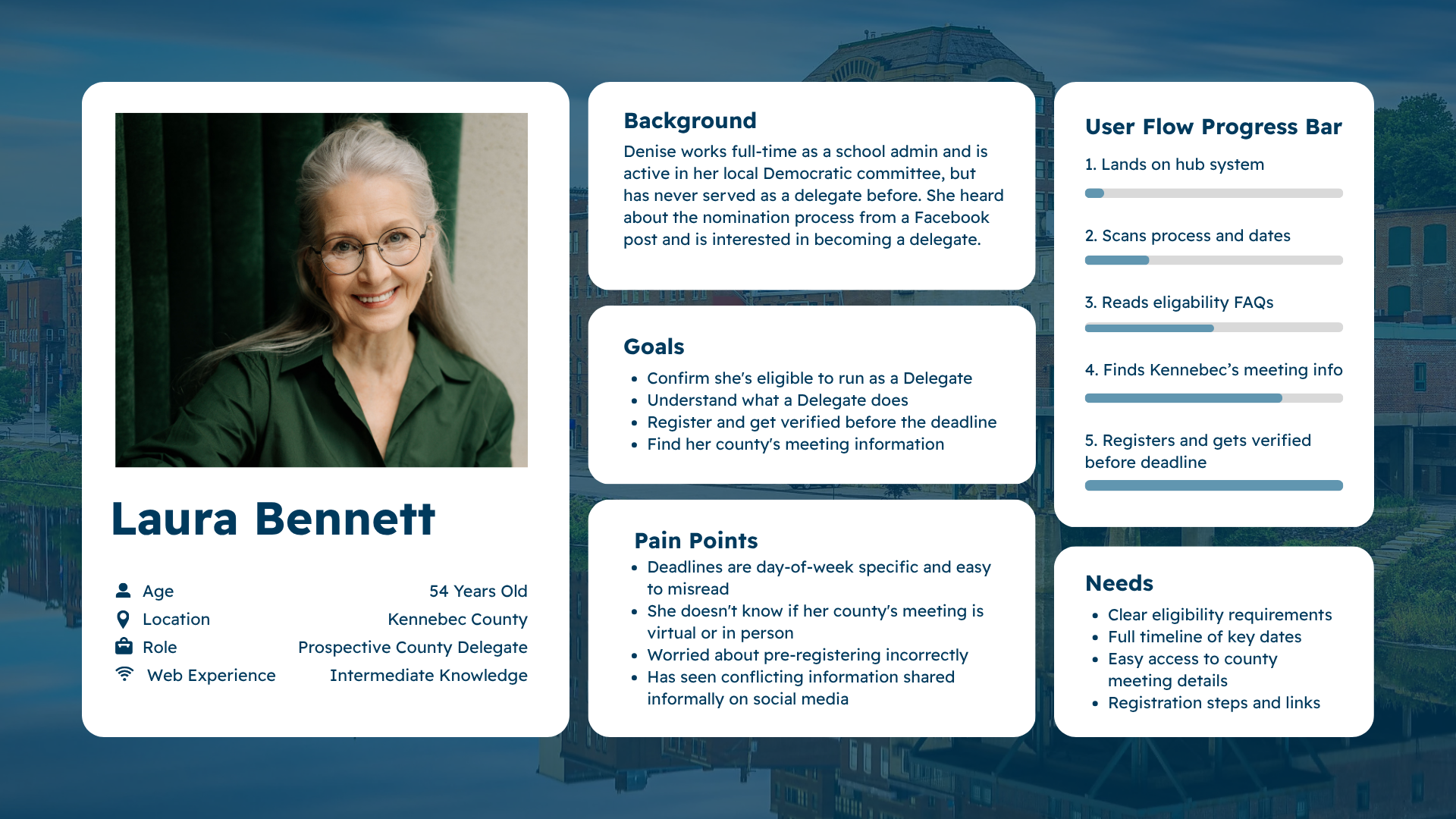
Creating personas for the 3 primary groups helped to frame what goals and needs the hub should answer, as well as to mitigate any pain points.
SOLUTION: Clear Process & Key Dates
zero ambiguity
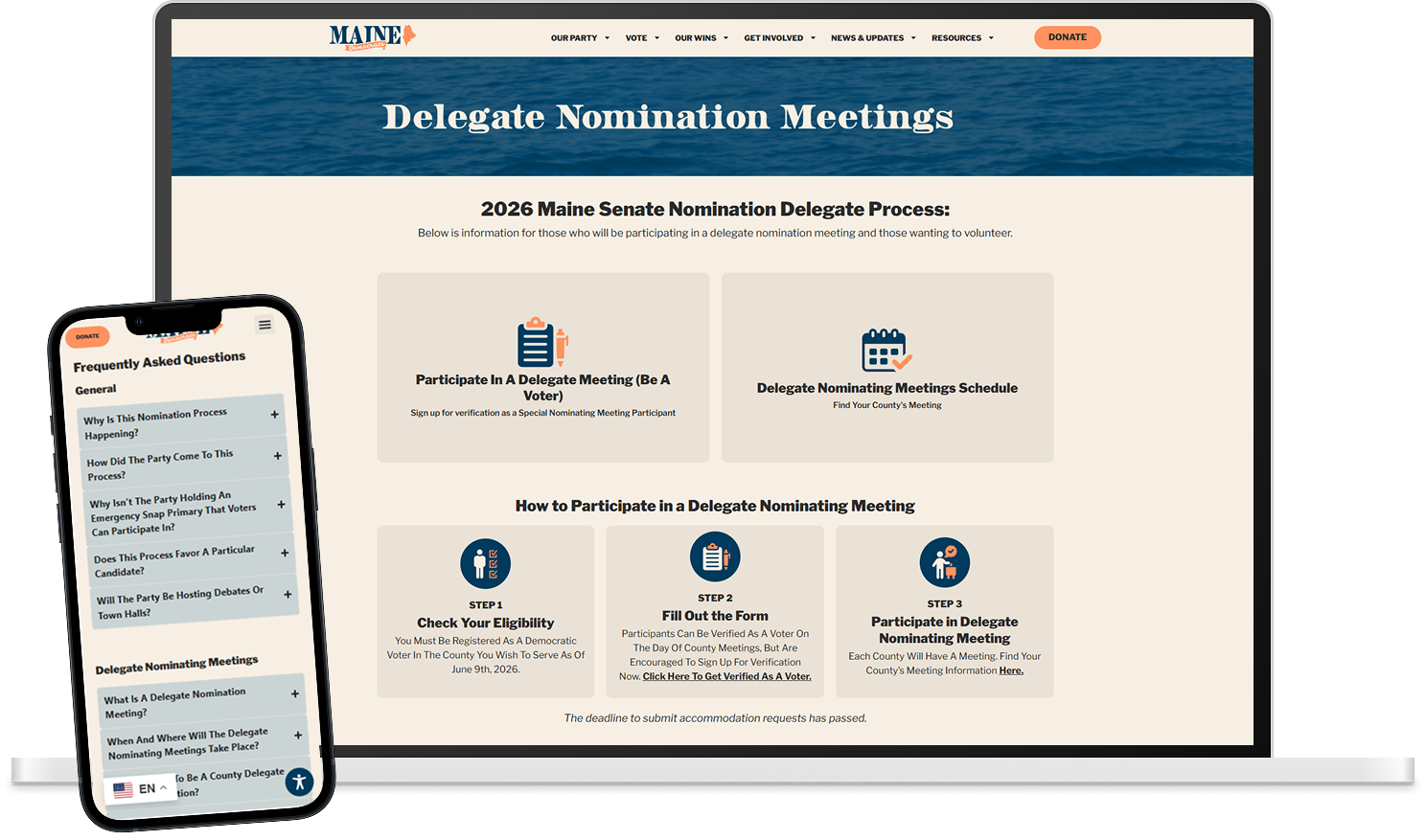
Plain steps, FAQ organized by who’s asking & direct links for any action steps.
The hub page opens with a three-step plain language summary: filing, county meetings, and convention. That is followed by a Key Dates section that turns statutory deadlines into a scannable timeline, with exactly what delegates and voters need to do and when.
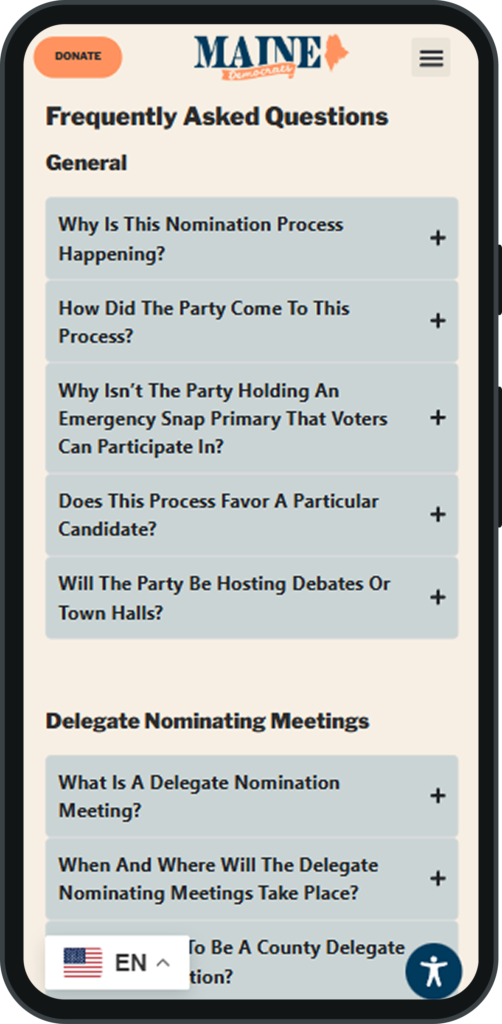
FAQs are grouped under ‘General’, ‘Delegate Nominating Meetings’, ‘Nominating Convention’, and ‘Press’ so a delegate candidate isn’t digging through reporter-facing questions to find their answer, and vice versa.
Solution: Quick and Clear Participation
Maximizing Mobilization
Subpages were designed with each persona in mind to ensure that they could get the information they need and reach their goals as quick as possible. Direct links to registration forms and FAQs were provided on every hub page, as well as step-by-steps to quell any confusion about the process and requirements.
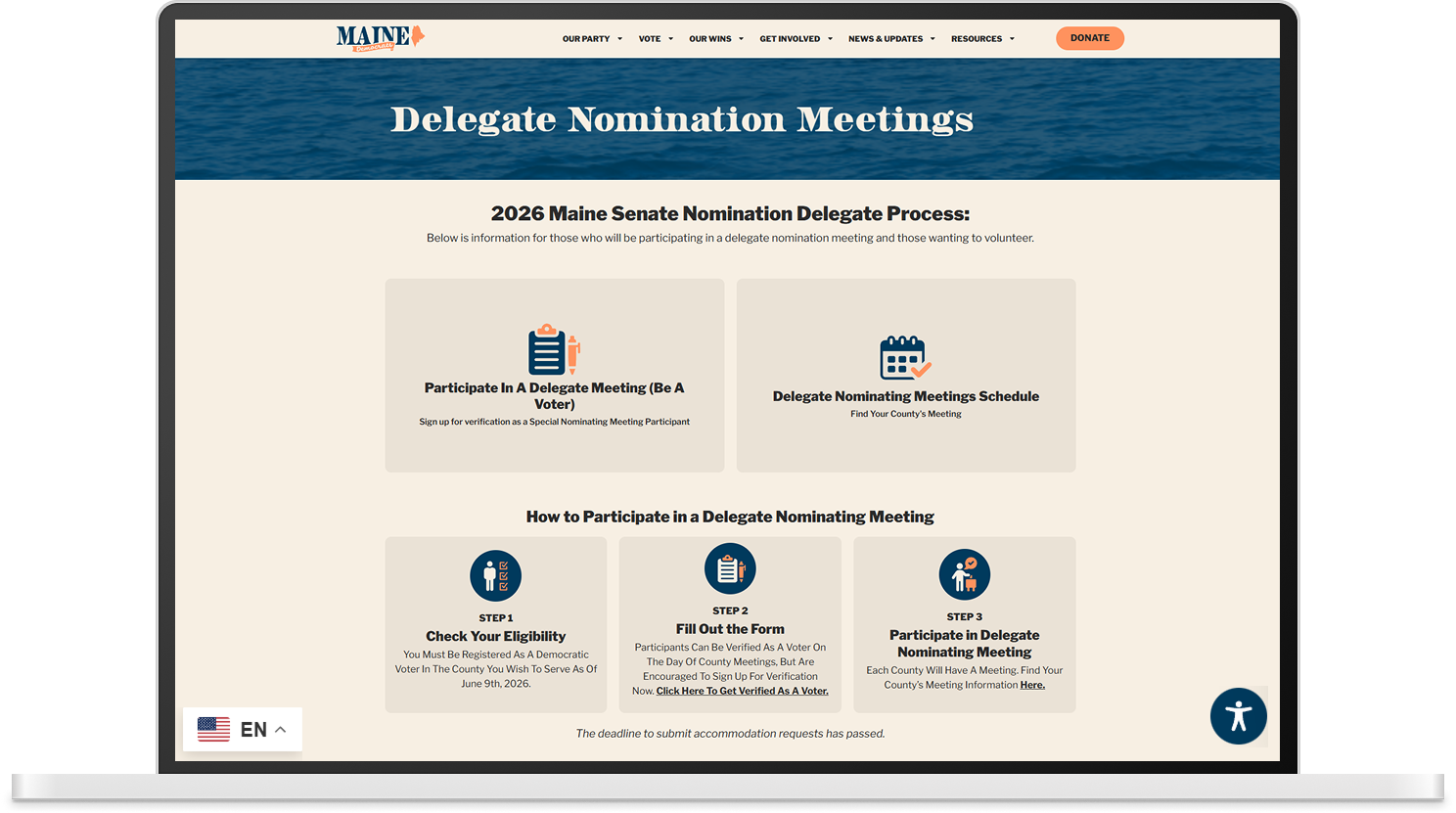
Making sure every eligible resident in Maine could participate was a high priority. Accessibility measures were offered on every page through an advanced accessibility overlay, translations to top languages in ME were added, and requests to provide accommodations at the convention and meetings were provided by the party.
Solution: County Delegate Guide
16 county meetings in 1 weekend
Every county needed its own meeting listing with names, check-in times, venues and virtual links published as soon as each county chair confirmed the details, planned and created days before the meetings happened. The system was built so that users could easily search for and locate their county without having to dig through 15 others first.
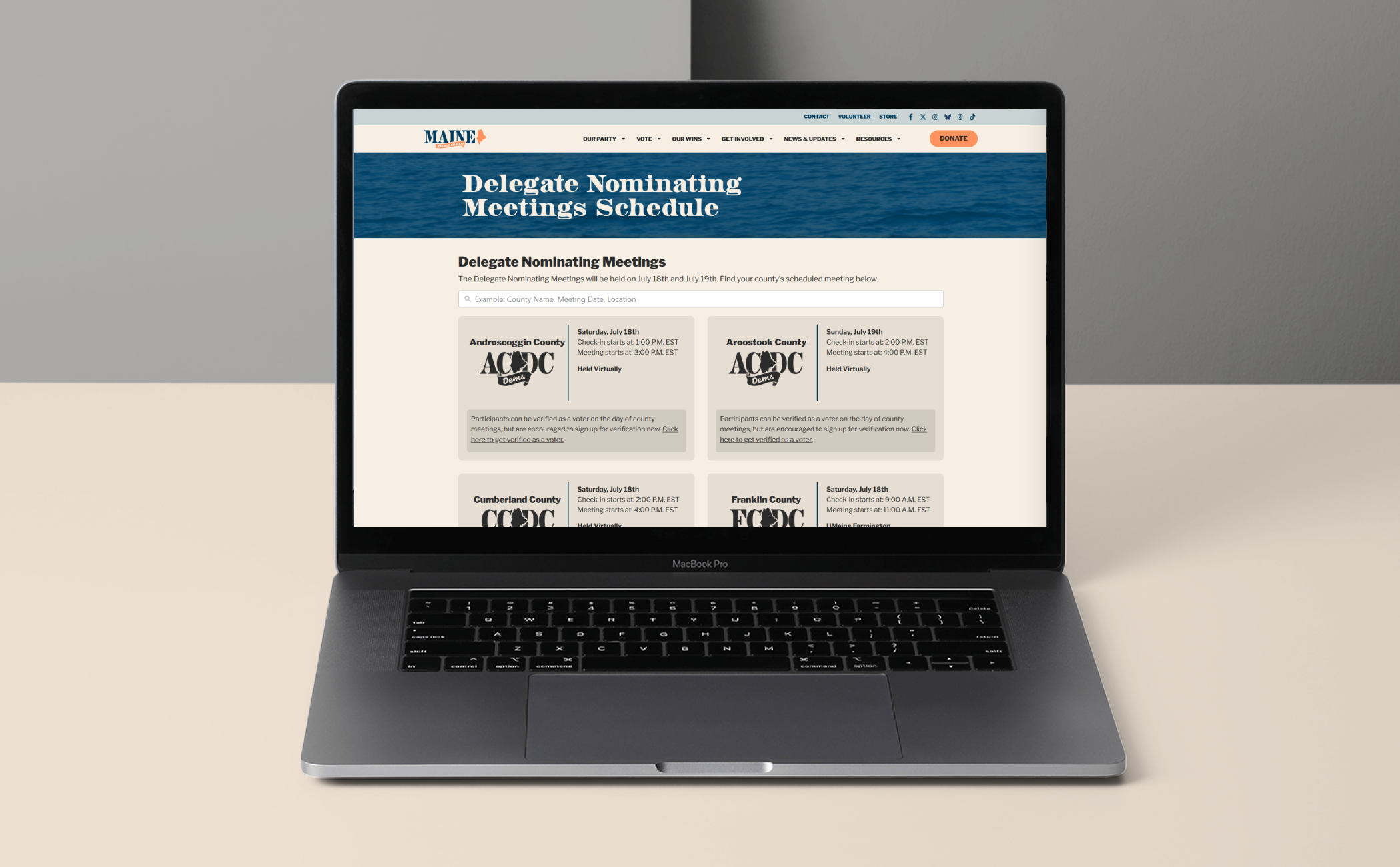
Roughly half the counties met virtually and half in person. The system was built so that toggling format, venue, and link only needed a quick content swap. Each county’s page links directly to that county’s voter-verification form, so registering to participate never required leaving the hub page.
Challenges & Tradeoffs
I Designed With These Challenges In Mind
Designing while the process was still being written
Rules for running as a delegate, voting rounds, and eligibility were finalized in the days immediately before launch. Content had to be structured so that a rule change meant editing a paragraph, not restructuring a page.
Correctness under legal and political scrutiny
This was a nationally covered Senate race. Inaccuracies would be a potential legal and political problem, so every answer traced back to a source document, and was tediously worked on in conjunction with the party.
No time for traditional user testing
With days to launch, validation happened through fast internal review with party staff who understood the process, rather than formal usability rounds. It meant a tradeoff of speed against rigorous process.
cohesive design with 16 counties
Format (virtual or in person), venue, and timing varied county to countys. The county module had to be flexible enough to hold both a Zoom link and a high school gymnasium address without looking like two different products.
Impact
What shipped
Built and launched in a week and a half, the Senate Process hub became the primary public source for how Maine would replace its Senate nominee. It reached more than 200,000 users and generated over 600,000 site views across the FAQ, key dates, candidate guide, and all sixteen county delegate pages during the nomination window.
Reflection
What I learned for my next project
Build the container before the content is final
The county module, the FAQ categories, and the candidate template were all designed to hold information that didn't exist yet. That's what made daily updates possible without daily rebuilds.
Measure twice & cut once
The most important design decision on this project was ensuring every piece traced to a source document, because the cost of being wrong was a lot higher than the cost of taking a bit more time to be done right.
Pressure Can Be A Good Thing
With so many novel processes and variables, I had to think on my feet about solutions that could be created quickly, easily managed/adjusted, and offered the clearest and simplest user experience. This caused me to think outside of the box and push my designs to the next level.